Major Group: Gastropoda
Order: Cerithimorpha (formerly within Neotaeniglossa)
Family: Thiaridae
All mainland freshwater species are in the family Thiaridae.
|
Descriptive Features: shells coiled (almost always dextral)
radula with 7 teeth in each row (central, and a pair of marginal and lateral teeth - taenioglossan condition)
eyes located on outer side (usually at base) of tentacles
sexes typically separate, rarely protandric hermaphrodites
eyes typically on bulges at outer sides of tentacle bases
also distinguished by ultra structural differences in the osphradium, sperm etc
shells typically elongate, aperture simple to channelled anteriorly
males lack a penis
shell elongate, coiled smooth or with sculpture
operculum coiled
males lack a penis
mantle edge smooth, weakly digitate or papillate
osphradium narrow, elongate
aperture typically simple anteriorly
Size
|
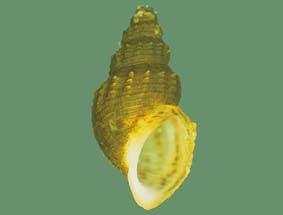
|
Thiara balonnensis |
|
|
|
Taxonomic Checklist: Genera
Melanoides tuberculata (Muller, 1774) (introduced
from Asia)
Melasma onca (Adams& Angas, 1864)
Plotia scabra
(Muller, 1774) (possibly introduced from Asia)
Plotiopsis
balonnensis (Conrad, 1850)
Ripalania queenslandica (Smith,
1882)
Sermyla
Stenomelania
Thiara
|
|
Distribution: SA, N WA, W WA, N NT, NE Qld, NSW
Sensitivity Rating: none
Functional Feeding Group: scrapers
|

|
tributary to Barron River, Kuranda Qld |
|
|
Ecology: Thiaridae species are intermediate hosts for a variety of tremode parasites of fish, domesticated animals and humans (lung fluke).
Instream habitat: Thiaridae species occur in running or stagnant freshwater, with a few able to tolerate brackish water such as dams and irrigation storages fed from the rivers where it survives and reproduces. They are found in soft sediments.
Feeding ecology: Thiarid snails are periphyton grazers.
Habit: Thiarid snails can withstand periodic droughts, possibly by burrowing deeper into the sediment.
Life history: Some Thiaridae species reproduce by parthenogenesis, an asexual form of reproduction found in females where growth and development of young occurs without fertilization by males.
|
| |
Information Sources: Ponder 2013, Smith 1992, 1996, 2002, Smith & Kershaw 1979, Beesley 2008, Wade et al 2004, Gooderham & Tsyrlin 2002
|
|
|
|

